

C'est un scénario classique de juillet : le soleil est torride, la famille nage tous les jours, et soudain vous remarquez que le niveau de l'eau semble un peu plus bas que la semaine dernière.
Immédiatement, la panique s'installe. Ai-je une fuite ? Vais-je devoir déterrer ma terrasse ? Combien cela va-t-il coûter ?
Avant de vous stresser, respirez profondément. Juillet apporte des températures maximales et une faible humidité, ce qui crée la tempête parfaite pour une évaporation rapide. En fait, une piscine typique peut facilement perdre jusqu'à 6 mm (environ 1/4 de pouce) d'eau par jour juste à cause de la chaleur et du vent.
Mais comment savoir si votre piscine ne fait que « transpirer » sous la chaleur de juillet ou s'il y a une déchirure réelle dans votre liner ou une fuite de plomberie ? Voici le test du seau sur 24 heures. C'est une astuce de bricolage simple et infaillible qui ne coûte presque rien. Voici comment procéder.
Comment effectuer le test du seau
Pour obtenir les résultats les plus précis, choisissez une fenêtre de 24 heures pendant laquelle personne ne nagera, et éteignez tous les remplisseurs d'eau automatiques si vous en avez.
Étape 1 : Prenez un seau
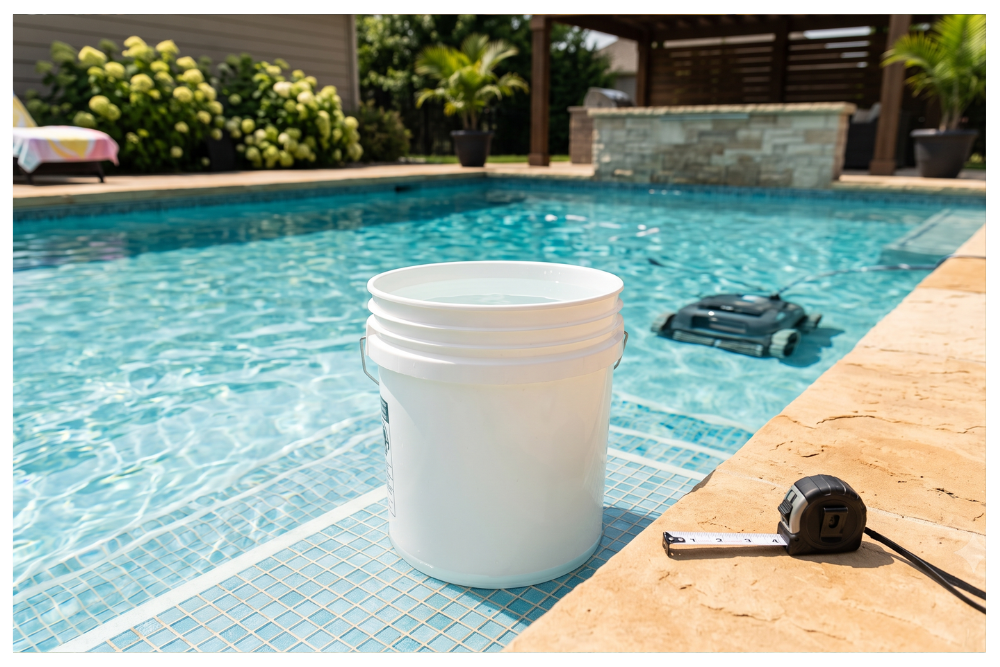
Procurez-vous un seau en plastique standard de 5 gallons (environ 19 litres). Remplissez-le d'eau de piscine jusqu'à ce que le niveau de l'eau à l'intérieur du seau soit à environ 7,5 à 12,5 cm (3 à 5 pouces) du bord supérieur.
Étape 2 : Préparez la scène
Placez le seau sur la première ou la deuxième marche de votre piscine, en submergeant le fond du seau dans l'eau de la piscine. (Cela garantit que l'eau à l'intérieur du seau reste exactement à la même température que l'eau de la piscine, reproduisant ainsi le même taux d'évaporation).
Étape 3 : Marquez les niveaux
- À l'intérieur du seau : Utilisez un marqueur indélébile ou un morceau de ruban isolant pour marquer le niveau exact de l'eau à l'intérieur du seau.
- À l'extérieur du seau : Marquez le niveau de l'eau de la piscine sur l'extérieur du seau.
Étape 4 : Attendez 24 heures
Laissez le seau tranquille pendant exactement 24 heures. Laissez la pompe de la piscine fonctionner comme d'habitude.
Analyse de vos résultats
Après 24 heures, prenez un mètre ruban et examinez attentivement vos marques.
Scénario A : Les niveaux ont baissé de la même manière.
Si le niveau de l'eau à l'intérieur du seau et le niveau de l'eau de la piscine à l'extérieur du seau ont baissé de la même quantité, félicitations ! Vous n'avez pas de fuite. Ce que vous subissez est purement une évaporation de juillet.
💡 Conseil pour lutter contre l'évaporation : Envisagez d'utiliser une couverture solaire la nuit pour retenir la chaleur et empêcher l'air sec de la nuit de voler l'eau de votre piscine.
Scénario B : Le niveau de la piscine a baissé plus que le niveau du seau.
Si le niveau de l'eau de la piscine à l'extérieur du seau a baissé significativement plus que le niveau de l'eau à l'intérieur du seau, vous avez probablement une fuite.
Que faire en cas de fuite ?
Ne paniquez pas ! La détection précoce d'une fuite prévient les dommages structurels et vous fait économiser de l'argent sur les factures d'eau.
Tout d'abord, faites une inspection visuelle rapide. Vérifiez autour de votre local technique de piscine pour toute flaque d'eau évidente, goutte à goutte ou sol mouillé. Examinez attentivement le liner de la piscine pour toute déchirure visible, en particulier autour de l'écumoire, des jets de refoulement ou des marches.
Ensuite, appelez Main Street Pools. Notre équipe d'experts peut vous aider à diagnostiquer le problème, vous guider à travers vos options, ou vous aider avec un service professionnel et des remplacements de liner vinyle pour que votre piscine soit étanche, correcte et prête pour le reste de l'été.

Laisser un commentaire
Ce site est protégé par hCaptcha, et la Politique de confidentialité et les Conditions de service de hCaptcha s’appliquent.