

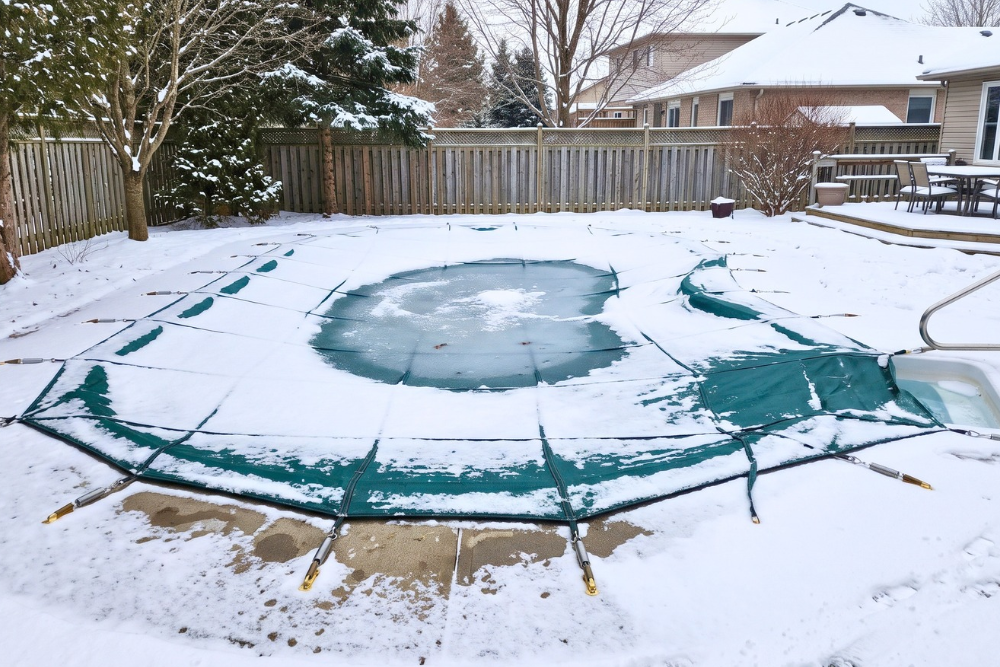
Once late November rolls into Uxbridge and the Durham Region, our weather rarely settles into a gentle, predictable winter. Between lake-effect snow squalls, freezing rain, and sudden January thaws, your winter pool cover takes a beating for five straight months.
The good news? A properly installed winter cover is built to handle Canadian winters, as long as you know when to let it do its job and when to step in. Here is how to safely manage snow, ice, and meltwater on your pool cover without tearing the material or damaging your vinyl liner underneath.
1. Know Your Cover Type: Safety Cover vs. Traditional Winter Tarp
How you care for your cover in winter depends entirely on which style is stretched over your pool:
- Mesh & Solid Safety Covers (Loop-Loc, Anchor, etc.): These covers are anchored into your pool deck with brass anchors and heavy-duty stainless-steel springs. They are engineered to hold massive snow loads, provided the water underneath is at the proper level. As snow piles on top, the cover stretches downward slightly until it rests on the ice and water below, which supports the weight.
- Lock-In & Tarp-Style Covers (with Water Bags): Standard solid vinyl covers rely on perimeter water tubes or bead tracks rather than deck tension. Because they aren't anchored to hold heavy loads, excess water and slush on top can pull the cover into the pool or strain your coping track.
Key Rule: Your pool cover is never meant to suspend hundreds of pounds of snow in mid-air. The ice and water inside your pool are what actually hold up the snow load.
2. The Golden Rule of Snow Removal: Step Away from the Shovel
In most cases, you do not need to remove snow from a safety cover. Leaving an insulating layer of snow on top actually protects the cover material from UV rays and sharp ice edges.
If a heavy wet storm or multi-day blizzard leaves an extreme load that causes your safety cover springs to compress completely flat against the deck, you can gently reduce the weight, but avoid these three common mistakes:
- Never use a metal shovel or ice chopper: Even a plastic snow shovel with a metal wear-strip can slice through woven mesh or solid vinyl in seconds. If you must clear light, fluffy snow, use a soft-bristled push broom or a foam roof rake, and always leave a 2-to-3-inch cushion of snow on the cover so you never scrape the fabric directly.
- Never use rock salt or chemical de-icers: Pouring ice melt onto a frozen pool cover won't safely clear it. Instead, the brine will seep through mesh panels (or wash over solid covers during a thaw), throwing off your spring water chemistry, corroding aluminum coping and stainless-steel hardware, and potentially bleaching your vinyl liner.
- Never walk on a snow- or ice-covered pool: Even a safety cover has limits when sharp ice sheets are shifting underneath. Stay off the cover all winter long.
3. Cover Pump Management: When to Run It and When to Pull It
Standing water on a solid winter cover or safety cover is normal during late-autumn rainstorms and mid-winter thaws—and left unchecked, a few inches of water across an 18' × 36' pool adds thousands of pounds of dead weight.
- During November & December Rain/Thaws: Keep an automatic submersible cover pump in the center of a solid cover so meltwater drains off before it freezes into a thick glacier.
- Before a Deep Freeze: Once temperatures drop consistently below freezing, bring your cover pump inside. If water freezes inside the pump housing or discharge hose, it will crack the impeller and burn out the motor the next time it tries to kick on.
- Watch Your Discharge Hose: Make sure the hose drains well away from your pool deck and house foundation so you don't create a skating rink around your backyard walkways.
4. Check the Water Level Underneath the Cover
One of the sneakiest winter pool hazards isn't on top of the cover—it's underneath. If a hidden leak, loose skimmer plug, or faulty hydrostatic valve allows your pool water to drop more than 18 inches below the coping, your safety cover loses its support system.
Without water pushing back up from beneath, the weight of snow and ice pulls straight down on the cover springs, deck anchors, and vinyl liner bead.
- How to check: During a mild winter afternoon, carefully unhook one corner spring (or lift the edge of a tarp cover) and shine a flashlight underneath.
- What to do if it's low: If the water level has dropped significantly below the skimmer, top it up with a garden hose on a day above 0°C so the cover stays properly supported. (If you notice water dropping repeatedly, make a note to have us pressure-test your lines in the spring.)
5. Clear Downspouts and Roof Overhangs
If your pool sits near your house, garage, or pool cabana, keep an eye on roof eaves. Heavy snow slides or dripping gutters crashing onto one corner of a pool cover create concentrated impact loads that can snap springs, bend anchor pins, or puncture a frozen cover. Redirect nearby downspouts away from the pool deck before the deep freeze sets in.
Need a Hand Before Winter Locks In?
Whether you need a replacement cover pump, extra water bags, replacement safety cover springs, or advice on how your pool is sitting heading into December, we're right here in town.
Stop by Main Street Pool & Spa at 37 Main St. N in Uxbridge, give us a call at (905) 852-9752, or reach out to our service team, we'll help make sure your pool coasts smoothly through winter and opens clean next spring.

Leave a comment
This site is protected by hCaptcha and the hCaptcha Privacy Policy and Terms of Service apply.